Showing posts with label PSC Corp. Show all posts

Monday, October 15, 2007

PSC Corp Stock Consolidation & Tips On IPO Application

After Share Consolidation

On 15 Oct 2007, PSC Corp’s shares consolidated five into one and traded at an open price of $0.52. This is close to what I had calculated in my previous posting on PSC. Unfortunately, PSC share closed at $0.48 which is lower than the theoretical price after the consolidation and rights issue. Of course, one day’s trading is not conclusive. It will probably take a few weeks to know whether PSC’s share price can maintain or surge above (and maintain) the theoretical price after share consolidation. Otherwise long-term investors will be worst of. They would be better of by disposing the shares before the consolidation. In this case, history has predictably repeated.

Whatever the ultimate outcome, my opinion is still the same. Share consolidation, generally, do not add value to the shareholders. It is a waste of time and the management, if indeed capable, should divert all efforts in bringing in profits.

Tips On IPO Application

In a bullish market like now, IPO is one idiot-proof way to make money. Many people rush into it and good IPOs are always numerous times over subscribed. Here I like to share a little tips on IPO application. It’s nothing big deal but for a beginner and a retail investor, this should be useful. If you are rich enough to apply for 100 of thousands of shares, this article will be irrelevant to you. So here are the tips:

1) When applying for IPO, always apply one lot (1,000 shares) or 11 lots (11,000 shares). Never in between.
2) Always apply near the end of the closing date. Never be the first hero.

Based on my ten years of experience, in a normal market, most IPO will usually be a few times oversubscribed. Normal market here refers to anytime other than a crisis or recession. When it is many times oversubscribed, every applicant will not receive the full quantity he/she applied for.

Refers to the picture above which is one of the recent IPO balloting result. Generally, those who applied from 1 to 9 or 10 lots will be thrown into the same balloting box. Let’s call this as Cat A. So it doesn’t matter whether you apply for 1 lot or 9 lots. You get same balloting ratio, same allotment, same probability. What you should do is to apply for eleven lots so that you can “jump category”. The next category will be for those applying, say, eleven lots to thirty, forty or fifty lots. So again, if you are slightly rich, it doesn’t matter if you apply for eleven lots or thirty lots - same balloting ratio, same allotment, same probability. Then you might as well apply for eleven lots.

The benefit of jumping category (let’s call the next higher category as Cat B) is that you are likely to enjoy one or two things. Firstly, the balloting ratio may change. For example, in Cat A, 5 out 50 applicants will get it, and Cat B 10 out of 50, depending on how hot is the IPO. So in Cat B, your chance increases. It’s not much but at least something. The second likely benefit will be the number of shares allotted may be different. In Cat A, successful applicants usually get one lot. In Cat B, successful applicants may get two lots. Again, this depends on how hot is the IPO.

Next, never rush to the ATM (or send your application form) immediately after the IPO is open for application. The market sentiment may change anytime. Mr. Market is temperamental, remember? If you apply the IPO early and suddenly Dow Jones plunged, there is no chance to retract. And then many people may change their mind about the application (to play safe), and you had it. You may be fully allotted. I usually applied an IPO during the last day.

“But between the IPO closing date and the official listing date, there may be bad news also?”

Yes that’s right but everyone had applied for it. And as usual, you won’t be fully allotted. You may get one or two lots but it’s not that bad. In any case, usually, an IPO will be listed within two or three days (some may be more) after the close of its application.

So in conclusion, IPO application is a probability game. I am sure many people can afford to apply eleven lots and thus giving yourself a better chance of getting it and getting more. Alternatively, if the IPO is underwrite by the broking house you used, call your broker/remisier and pressure him/her for private placement.

Sunday, September 30, 2007

Share Consolidation - PSC Corp

Share Consolidation

When a company finds that the quantity of its issued share is too large and thus resulted in poor performance in share price, it may resort to consolidate its shares. Compare to stock split, you don't see a consolidation often in SGX. By share consolidation, company will merge the shares into smaller quantity, e.g. every 5 shares into 1. If that’s really the main motive of that company, in my opinion, the management is just wasting their time to do something that has no impact on shareholders’ value. If a company is profitable and has sustainable growth, share quantity is never an issue. For example, Singtel has almost 16 billion share floating, but that does not make its share price stagnant or to hovers at low price. On the contrary, Singtel’s shares are always actively traded and with better performance in recent years, especially after their acquisition of Australia’s Optus, Singtel’s share price has been moving up gradually. In mid-2003, Singtel’s share was traded below $1.40. But in Sep 2007, it’s share price break through $4, and this is not the first time Singtel share price reach this height. The strength in rising share price, besides bullish market, was better profit. This is a fundamental we are talking about. And a good management team should divert 100% effort and time into this fundamental.

Experience From Beyonics Tech

In Sep 2003, Beyonics Tech announced its plan to consolidate five shares into two. At the time of announcement, Beyonics Tech has 1,138,334,628 issued shares. In their announcement, the company mentioned that ”the directors are of the view that share consolidation may increase the profile of the company amongst the institutional investors and make the shares more attractive to such investors and thus, increase interest in the shares. Shareholders should note, however, that there can be no assurance that this can be achieved as a result of the share consolidation……” As you can see, the directors' view is "say like no say". One of my friend who followed me to buy Beyonics Tech much earlier asked for my opinion on our course of action. I told him to lock-in our profit and run before the consolidation. And we did.

“What is your basis of such recommendation to your friend?”

Well, firstly, as I mentioned, increasing share profile by consolidation makes no economic sense. I interpreted it as “nothing better to do”. I would prefer that the management spend more time and all effort to improve their bottom line. If a company can prove to the investors that their new initiatives have resulted in higher and sustainable revenue, there would be a demand, and then more than supply and the share price would move up. Before 2002, Beyonics Tech’s net profit was rather unattractive. My second reason was due to uncertainty. You don’t find many share consolidation activities here (in SGX) compare to stock split. So after the consolidation, will the share price stay or surge above after-exercise price? Obviously nobody knows and that is an uncertainty. Uncertainty equals to risk. Is there any catalyst to propel the share price after the consolidation? If not, then the risk will be high. If the company concerned has a visible growth trend, then share consolidation doesn’t matter at all.

After Beyonics Tech’s share consolidation, the exercise price should be about $0.675. This means that if you hold 5,000 shares before the consolidation, it will become 2,000 after the consolidation and the market will adjust the price accordingly. After the consolidation, Beyonics Tech’s share price was indeed strong at the beginning and surged to about $0.80. Unfortunately, within half a year, its share price dropped below $0.60. Poor market sentiment was also to be blame. The share price continued to head south until finally in 2005, my friend and I bought Beyonics Tech’s shares again at around $0.31. As you can see, long-term investors got a slap for nothing. For me and my friend, we got a good bargain plus little profit that we had locked in previously.

PSC Corp

Sometime back, a few friends had asked for my opinion on PSC Corp. I gave very negative remarks. The reason was due to a very bad incidence which I can never forget (and forgive). In 2003, PSC Corp’s Board announced a share option scheme. Its share price was then traded just slightly above $0.10 yet the management set the exercise price at around $0.085!!! An option scheme was supposed to be used as a carrot for staff to work hard and improve company’s result, not for instant gain. I mean out of sudden, the company employees sit on unrealized gain. Why would they need to work hard since they are already sitting on unrealized gain? This issue was also brought up by analysts on the paper. Immediately after that announcement, I have no confidence and faith on the management team. I dumped the shares at small losses.

In Jun 2007, PSC Corp announced their proposal to consolidate five shares into one. At the same time, company also proposed to issue additional shares of one right share @ $0.33 for every two consolidated shares. At the time of the announcement, PSC Corp has 1,868,655,825 issue shares. On 29 Sep 2007, PSC Corp’s announced the date of its book closure. The share was then traded between $0.115 and $0.12. Based on this announcement, and using $0.115 as a guide, the theoretical after-exercise price should be approximately $0.50. Now, the critical question is whether the price will drop below this theoretical price subsequently? This is a difficult question. But I have some points for you to think about it:

1) In Sep 2007, STI break through 3,700 points despites yet-to-resolve US subprime problem.
2) US consumer confidence was reported at year low in Sep and new home sales dropped to 7-years low.
3) Many analysts still believe that a recession is coming.
4) Oil price is expected to surge further.
5) Does PSC Corp has any catalyst or sustainable growth?

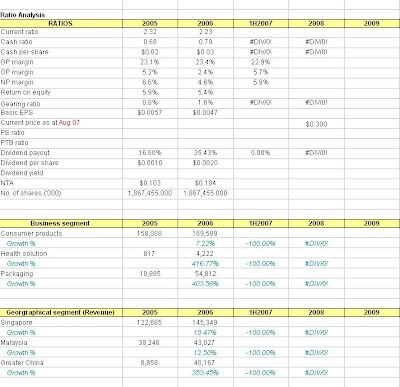
I had produce a summarised financial report on PSC Corp for analysis.

Without going into the detail, my conclusion from the analysis is that there is really nothing to shout about. No doubt the company is financially healthy, but what about returns? The margins are thin, ROE hardly reach 6% (my annual returns from stock investment is already above 10%), the yield is pathetic etc. However, it may be interested to note that PSC Corp has two listed subsidiaries: Tat Seng Packaging (64% holdings) and Intraco (29.9% holdings). Also in Sep 2007, Goi Seng Hui has increased his stakes in PSC Corp from 13.9% to 14.3%.


In conclusion, in my opinion, share consolidation is meaningless if it used as a mean to “boost share trading”. In fact, I can’t think of a meaningful reason to consolidate the shares. The highly-paid management team should always focus on the fundamental, i.e. profit growth. They should spend all their effort in improving bottom line and leave the share price to the market forces. If you are currently holding PSC Corp with a short-term perspective, the above five questions may help you to decide whether to quit before or after the book closure.

2009 F1 Singtel Singapore Grand Prix - 27 Sep

Life at NUS-CMC, and still happening......

Visit www.moblyng.com to make your own!